
The following article was written by Ned Biggs and published in Fishing News
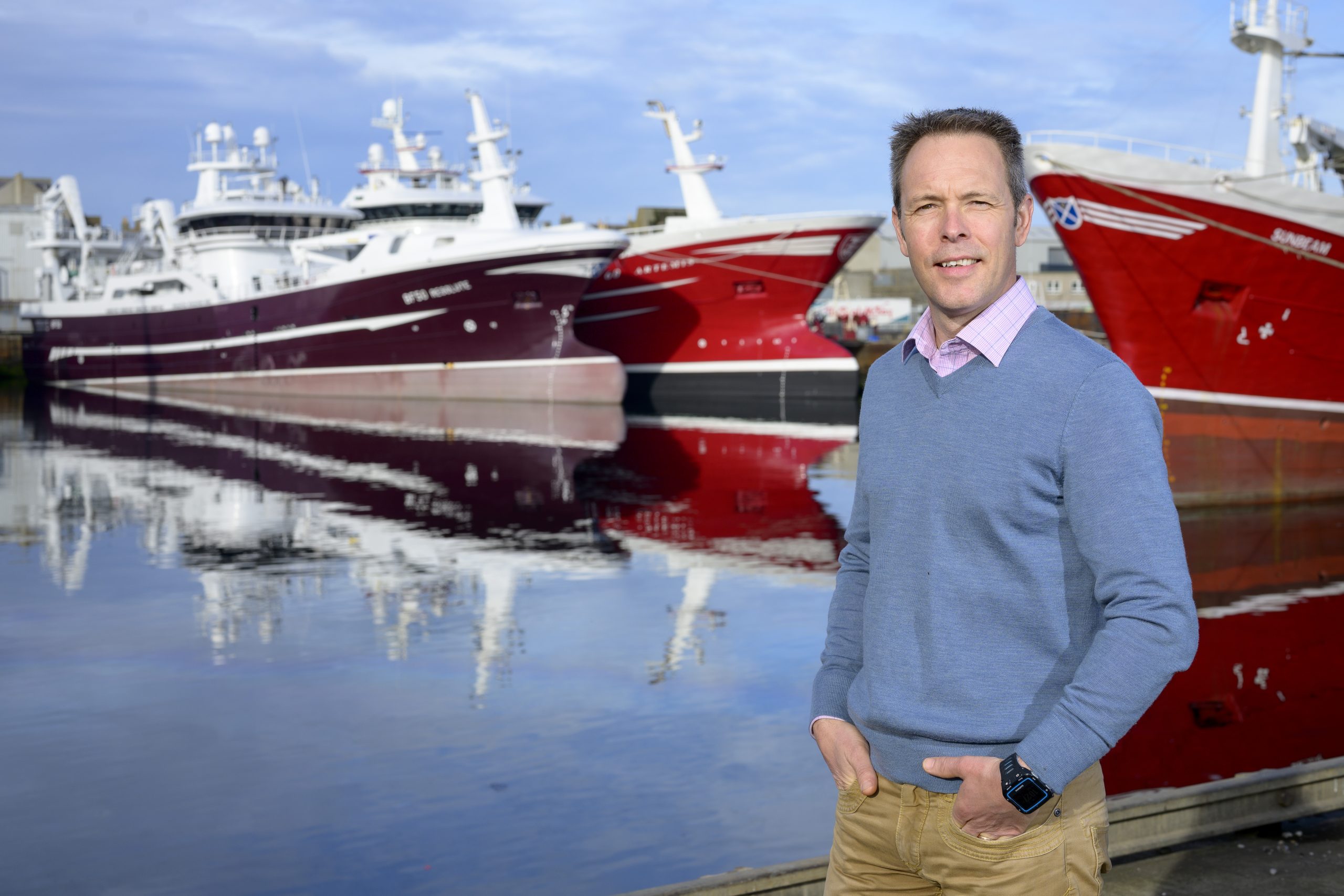
For many in scientific community, there’s a clear distinction between formal academic research and the commercial realities of the catching sector. For Dr Steve Mackinson, chief scientific officer for the Scottish Pelagic Fishermen’s Association (SPFA), dismantling this division is central to his role. Now in his 10th year with the association, Steve operates as a vital strategic bridge.
“I bring science to industry, and I bring industry to science,” he explained. He divides his time between unpacking dense international data and working directly with Scottish skippers to ensure commercial catch information is accepted at the highest levels of marine governance.
While the SPFA is anchored in the bustling port of Fraserburgh, Steve’s daily workflow is based around his home in Suffolk. This location is a legacy of his previous 17-year tenure as a senior researcher at the Cefas laboratory in Lowestoft. Today, his weeks are structured around the shifting demands of the fleet, requiring regular journeys up to Scotland, across to the ICES headquarters in Denmark and to various marine institutes globally.
His career path was set at an early age. “I always had a passion for what’s under the water, and a fascination with fish – whether it was born from a bit of ad hoc angling with my dad, or just exploring waterways as a kid. I like sticking my head underwater and finding out what’s under there.” This early enthusiasm guided his academic career across three universities, culminating in a fisheries science PhD in British Columbia, Canada. It was there that he first recognised the value of collaborating with commercial fishermen, a principle that has driven his research philosophy ever since.
When logging on in the mornings, Steve’s immediate priority is managing the balance between time-sensitive demands and long-term strategic projects. A significant portion of his desk hours are spent acting as an interpreter for complex data, such as unpacking annual ICES advice to make it decipherable for SPFA members and supply chain partners. He also frequently collaborates with industry bodies like the Scottish Fishermen’s Federation and Fishing into the Future to foster transparent discussions across the sector
A cornerstone of Steve’s work is the Scottish Pelagic Industry Science Data Collection Programme. Initiated in 2018, this voluntary scheme achieved the full participation of the Scottish SPFA fleet by 2021, with every vessel collecting biological sample data from every single haul. Remarkably, this industry led initiative (now a formal partnership between the SPFA, the Scottish Government Marine Directorate and the University of the Highlands and Islands) has now entirely replaced the previous Marine Directorate pelagic catch sampling programme, with the data being submitted to ICES for use in stock assessments.
While Steve maintains high-level strategic oversight of the programme, the daily co-ordination is now managed by Katie Brigden, a pelagic scientist based at UHI Shetland, freeing Steve to focus on the evolution of the data streams and development of new science projects relevant to the pelagic sector.
A major, urgent project is mapping the spatial squeeze caused by rapid offshore wind farm development. To combat the lack of fine-scale data available to developers, Steve spent months visiting vessels to download decades of plotter data directly from the skippers.
What followed were painstaking months in front of his computer, cleaning what he describes as ‘messy data’ to standardise it into a robust, fleet-wide evidentiary tool. The precision of this industry derived data has provided unprecedented leverage in policy discussions. The methodology Steve pioneered has since been shared with Seafish mapping teams and others, and has even formed the basis of a PhD study at UHI Shetland.
Other endeavours that take up Steve’s time include the Catch to Batch workstream, which enables catch traceability and derives unique scientific data from factories, and work on emerging concerns like fish welfare. Just last week, he co-submitted a collaborative research proposal examining the future of humane slaughter within pelagic fisheries. Acknowledging the logistical challenge of processing massive volumes of fish pumped aboard at high speed, Steve emphasises that because this is the way the policy wind is blowing, the industry must be proactive in its engagement.
His daily work also addresses bycatch mitigation; he works with UHI Shetland on routine monitoring to help identify where mitigation measures may need to be developed. By working with skippers and net makers to implement internal separator grids within nets, Steve helps ensure that non-target species are excluded safely, saving valuable processing time for the crew.
To successfully execute these diverse programmes, Steve structures his annual calendar around the operational rhythms of the fleet and processing factories. He schedules intensive site and factory visits during the quiet windows between core fishing seasons so as not to disrupt commercial workflows.
Reflecting on his journey from a PhD student studying herring in Canada to executing his collaborative vision for the Scottish pelagic fleet, Steve said: “It’s magical. To have the opportunity to do something that matches really well with what I’m interested in and passionate about is just fantastic. It’s not always easy, but it is rewarding.”
Even when the working day concludes, separating himself from the aquatic world remains a challenge. On a warm summer afternoon, Steve’s ideal method for switching off involves heading straight back to the water. To balance the long screen hours, he maintains a fitness routine that also includes running and cycling. “My plan today is to go down to the river and stick my head under the water and see some fish,” he said. “I love wild swimming, so I’ll be in the river today because it’s beautiful and clear. It’s just fantastic.”